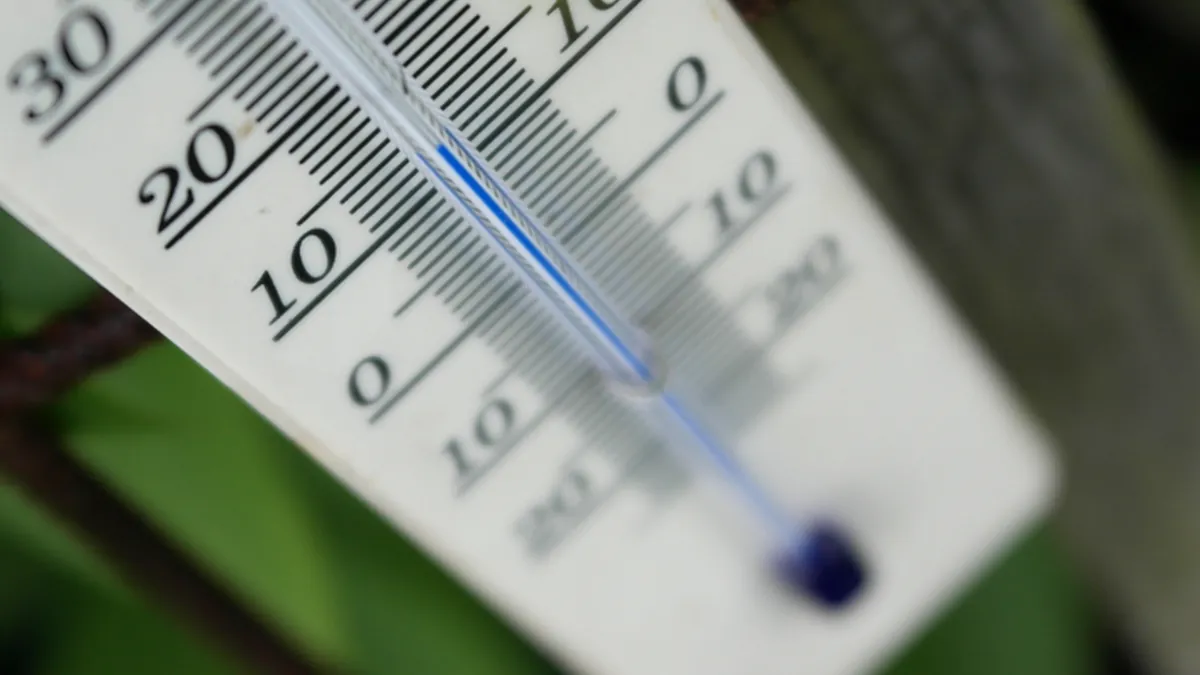
To convert Celsius to Fahrenheit, multiply the Celsius temperature by 9/5 and add 32: °F = °C × 9/5 + 32. So 30°C becomes 30 × 9/5 = 54, plus 32, which is 86°F. To go the other way, subtract 32 first, then multiply by 5/9: °C = (°F − 32) × 5/9, which turns 86°F back into exactly 30°C. This guide walks through both formulas step by step, a faster mental shortcut with an honest account of its error, a full conversion chart, and the mistakes that catch almost everyone the first time.
The United States still reports weather, oven temperatures and body temperature in Fahrenheit, while most of the world — and nearly all science — uses Celsius. That means travelers, home cooks following European recipes, parents reading a thermometer bought abroad, and anyone comparing product specifications regularly has to translate between the two scales. The good news is that the relationship is perfectly linear: one formula, no lookup tables required, although a chart still helps for the values you meet every day.
Where the Two Scales Come From
A little history explains why the scales differ at all. Daniel Fahrenheit built his scale in the early 1700s, setting 0°F at the coldest temperature he could reproduce with a salt-and-ice mixture and body temperature near the top of his range; the scale was later re-anchored so that water freezes at 32°F and boils at 212°F. Anders Celsius proposed his scale in 1742, splitting the freeze-to-boil interval into exactly 100 degrees — which is why Celsius conversions involve the tidy fraction 9/5, and why the scale was originally called centigrade, Latin for a hundred steps. Celsius also anchors the scientific Kelvin scale: 0°C is 273.15 K, and a change of 1°C is exactly a change of 1 K, so Celsius-to-Kelvin conversion is a single addition. The United States kept Fahrenheit when most other countries switched during the 20th century, and the two systems have coexisted ever since.
The Celsius to Fahrenheit Formula, Step by Step
The formula is °F = °C × 9/5 + 32. Two operations, always in this order: first multiply by 9/5 (the same as multiplying by 1.8), then add 32. The 9/5 exists because the Fahrenheit degree is smaller: between water freezing and boiling there are 100 Celsius degrees but 180 Fahrenheit degrees (from 32°F to 212°F), and 180 ÷ 100 simplifies to 9/5. The +32 exists because the two scales start at different places — water freezes at 0°C but at 32°F — so every converted value shifts up by 32.
Worked example: convert 25°C, a warm spring day. Step 1: multiply by 9/5 — 25 × 9 = 225, and 225 ÷ 5 = 45 (equivalently, 25 × 1.8 = 45). Step 2: add 32 — 45 + 32 = 77. So 25°C = 77°F. Notice that the halfway result, 45, is not the answer; forgetting the +32 is the single most common error with this formula, and it is covered again in the mistakes section below.
Worked example with a negative temperature: convert −10°C, a cold winter night. Step 1: −10 × 9/5 = −18. Step 2: −18 + 32 = 14. So −10°C = 14°F. Carry the negative sign through the multiplication before adding 32, and the arithmetic stays clean. If your answer for a temperature below freezing comes out above 32°F, you have almost certainly dropped the negative sign somewhere along the way.
How to Change Fahrenheit into Celsius
To convert Fahrenheit to Celsius, reverse both operations in reverse order: subtract 32 first, then multiply by 5/9. The formula is °C = (°F − 32) × 5/9. Worked example: average body temperature, 98.6°F. Step 1: 98.6 − 32 = 66.6. Step 2: 66.6 × 5/9 — 66.6 × 5 = 333, and 333 ÷ 9 = 37. So 98.6°F = 37°C exactly. The Celsius to Fahrenheit converter runs both directions, which is handy when you are converting a whole recipe or a week of forecast temperatures at once.
A few anchor points make sanity-checking easy. The scales cross at −40, the only temperature that reads the same on both: −40°C = −40°F. Water freezes at 0°C = 32°F and boils at 100°C = 212°F at sea level. Room temperature is roughly 20–22°C, or 68–72°F. If a conversion lands far from where these anchors say it should — for example, a result that puts a summer day below freezing — the formula was applied in the wrong order or the wrong direction.
The Quick Mental Shortcut (Double and Add 30) and Its Real Error
For weather temperatures, a popular shortcut is: double the Celsius value and add 30. It is exact at exactly one point — 10°C: 10 × 2 + 30 = 50, and the exact answer is also 50°F. Away from 10°C the error grows steadily, by 0.2°F for every degree Celsius you move away from 10. The honest error table looks like this: at −10°C the shortcut gives 10°F against an exact 14°F (error −4); at 0°C it gives 30°F against 32°F (error −2); at 10°C it gives 50°F against 50°F (error 0); at 20°C it gives 70°F against 68°F (error +2); at 30°C it gives 90°F against 86°F (error +4); at 37°C it gives 104°F against an exact 98.6°F (error +5.4); and at 40°C it gives 110°F against an exact 104°F (error +6).
That pattern tells you exactly when the shortcut is safe. For deciding whether to wear a jacket, being 2–4°F off changes nothing, and the shortcut is a genuinely useful piece of mental math roughly between 0°C and 25°C. For a fever reading, an oven, a chemistry class or anything involving a small child, the error is larger than the precision you need — a shortcut reading of about 104°F for 37°C would wrongly suggest a high fever in a healthy person. Use the exact formula, or the converter, whenever the number drives a decision.
Celsius to Fahrenheit Conversion Chart
The chart below covers the temperatures people actually look up — weather, body temperature and oven settings. Read it across: −40°C = −40°F (the crossover point); 0°C = 32°F (water freezes); 10°C = 50°F (a cool day); 15°C = 59°F (mild); 20°C = 68°F (room temperature); 25°C = 77°F (a warm day); 30°C = 86°F (a hot day); 36°C = 96.8°F (the low end of normal body temperature); 37°C = 98.6°F (average body temperature); 38°C = 100.4°F (the standard fever threshold); 40°C = 104°F (a high fever, or a heatwave day); 50°C = 122°F (extreme heat); 100°C = 212°F (water boils); 180°C = 356°F (a standard baking temperature); 200°C = 392°F (a hot oven).
Converting the Temperatures You Actually Meet
Weather is where most conversions happen. A European vacation forecast of 28°C is 28 × 1.8 + 32 = 82.4°F — a warm beach day. A winter forecast of −5°C is −5 × 1.8 + 32 = 23°F, well below freezing, so ice is likely. A useful counting trick: every 5°C step is exactly a 9°F step, so once you know 20°C = 68°F you can count up or down in nines — 25°C = 77°F, 30°C = 86°F, 15°C = 59°F — without any multiplication at all.
Body temperature is the conversion where accuracy matters most. A healthy adult's temperature usually falls between 36.1°C and 37.2°C (97–99°F), and 38°C (100.4°F) is the widely used fever threshold. Because the shortcut method is off by more than 5°F in this range, always convert body temperatures with the exact formula. If you are checking a reading against the fever line, our guide Is 38°C a Fever? explains how the threshold works for adults, children and babies, and why the measurement site changes the number you get.
Oven temperatures are the third everyday case. Most European recipes bake at 180°C, which is 356°F — American ovens are normally set to 350°F for the same dish, the small rounding already being built into most recipes. A hot oven at 200°C is 392°F, usually set as 400°F, and a slow oven at 150°C is 302°F, set as 300°F. Fan (convection) ovens run about 20°C lower than the conventional temperature printed in older recipes, whichever scale you happen to work in.
For the oven, a short list of standard settings covers most recipes: 150°C = 302°F (set 300°F, slow); 160°C = 320°F (set 325°F); 175°C = 347°F (set 350°F); 180°C = 356°F (set 350°F); 190°C = 374°F (set 375°F); 200°C = 392°F (set 400°F); 220°C = 428°F (set 425°F); 230°C = 446°F (set 450°F). Notice that American oven dials move in 25°F steps, so most Celsius settings land between two dial marks — recipes tolerate the nearest setting, because home ovens cycle above and below the set point by more than that gap anyway. Precision matters for sugar work and chocolate, though; there, convert exactly.
Common Conversion Mistakes
Four mistakes account for nearly every wrong conversion. First, adding 32 before multiplying — the order is multiply, then add (and on the way back, subtract, then multiply). Second, using the wrong fraction: Celsius to Fahrenheit uses 9/5 and Fahrenheit to Celsius uses 5/9, and swapping them produces answers that are not even close to the anchor points. Third, dropping negative signs on sub-zero temperatures, which turns a frost into a mild day. Fourth, trusting the double-and-add-30 shortcut for fevers or baking, where its error of up to 6°F is bigger than the margin you are trying to judge. Checking your answer against the −40, 0°C and 100°C anchors catches all four.
Converting Celsius to Fahrenheit is one multiplication and one addition: multiply by 9/5, then add 32 — and reverse the steps with 5/9 to come back. Learn the anchors (−40, 0/32, 37/98.6 and 100/212), keep the shortcut for rough weather guesses only, and reach for the exact formula whenever the number matters. For anything longer than a single value, the Celsius to Fahrenheit converter converts in both directions instantly, with no risk of dropping a sign or a 32 along the way.