Volume is not weight
A cup of flour and a cup of honey are both “one cup,” and they weigh wildly different amounts — which is why cups to grams conversions trip up even confident cooks. Cups measure volume, grams measure weight, and converting between them requires knowing the density of whatever is in the cup. There is no single conversion factor, and anyone selling you one is selling you lumpy cake.
The core rule fits in one sentence: weight equals volume times density. A cup of a dense ingredient weighs more than a cup of a fluffy one, full stop. Water is the friendly reference point — one US cup of water weighs about 236 grams — and everything else is heavier or lighter depending on how much air and structure it packs into that cup.
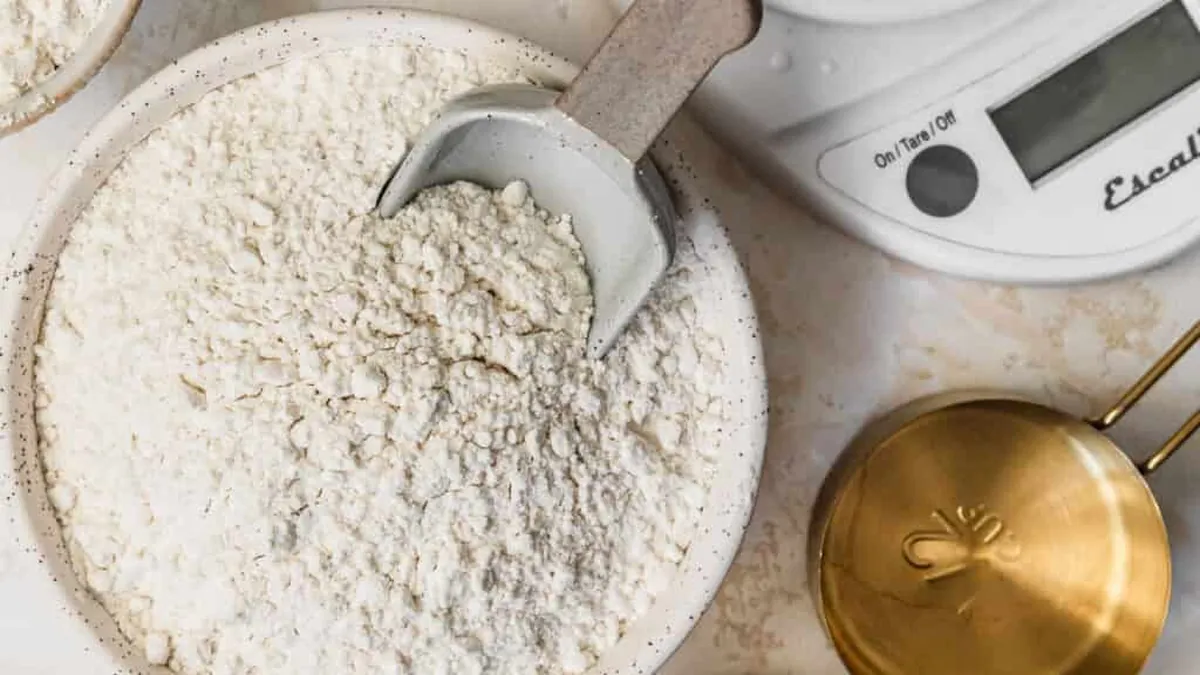
Flour is the tricky one, and it deserves its reputation. A cup of all-purpose flour can weigh anywhere from about 120 grams to 155 grams depending on how it got into the cup. Scoop straight from the bag and you pack it down; spoon it in lightly and level it off and you get the airy end of the range. That 30-gram swing is the difference between tender bread and a brick, and it is the single biggest reason recipes fail across kitchens.
The fix for flour is technique, not a better chart. Spoon the flour into the cup until it mounds over the top, then sweep a straight edge across to level it — no tapping, no shaking, no packing. Done this way, a US cup of all-purpose flour lands reliably around 120 to 130 grams, which is the figure most professional baking references standardize on. Better still, weigh it: 125 grams of flour is 125 grams of flour in every kitchen on earth.
The ingredients you convert most
Granulated sugar is far better behaved. The crystals settle consistently no matter how you pour, so one US cup of white sugar weighs about 200 grams with very little variation. This is why sugar-heavy recipes survive cup measurements while flour-heavy ones do not — the ingredient forgives sloppy measuring. Brown sugar is the exception: it must be packed into the cup, and a packed cup weighs about 220 grams.
Butter plays by its own rules because American packaging did the conversion for you. One US cup of butter is exactly two sticks, and two sticks weigh 227 grams — eight ounces, half a pound. If a recipe calls for a cup of butter, you are really being asked for 227 grams, and most of the world just buys it in 250-gram blocks and cuts accordingly. Melted butter, note, is a different matter: melt it first and a cup weighs less because the air whipped into the stick escapes.
Honey, molasses, and syrups sit at the heavy end of the scale because sugar is dense and there is almost no air in the cup. One US cup of honey weighs roughly 340 grams — nearly half as much again as the same cup of water. This matters when you scale recipes: doubling the honey doubles a serious amount of weight and sweetness, so measure sticky ingredients by weight whenever you can and save yourself the scraping.
Cocoa powder is flour’s moody cousin. Unsifted and scooped, a cup can pack down toward 120 grams or more; sifted lightly, it sits near 100 grams. Since cocoa is potent stuff, that 20 percent swing changes a chocolate cake’s character noticeably. The professional standard hovers around 100 grams per cup for sifted cocoa, and again, the scale removes the argument entirely.
A few more everyday figures, all for one US cup, all approximate because brands and humidity vary. Rolled oats: about 90 grams — all that air between flakes. Uncooked long-grain rice: roughly 185 to 200 grams. Chopped nuts: around 120 grams. Grated hard cheese like parmesan: about 100 grams. Milk and other thin liquids: 240 grams or so, a touch more than water. Treat these as starting points and adjust to taste, especially with the forgiving ones.
Now the uncomfortable question: which cup? The US customary cup is about 236.6 milliliters, the metric cup used in much of the world is an even 250 milliliters, and older British imperial recipes mean 284 milliliters when they say a cup. A recipe that does not say which cup it means is already approximate, and converting its cups to grams inherits that fuzziness. When precision matters, identify the cup first or bypass it with the scale.
Which cup are we talking about
The cup-size gap is about six percent between US and metric, which sounds small until it compounds. Six percent on every ingredient of a delicate cake is the difference between the recipe the author tested and the one you baked. For a soup, nobody will notice. Learn to ask “which cup” the way you would ask “which oven temperature scale” — it is the same class of mistake.
Dry measuring cups and liquid measuring cups are genuinely different tools. Dry cups are meant to be filled to the brim and leveled; liquid cups have headspace and a spout so you can read the meniscus at eye level. Using a liquid cup for flour means guessing at the fill line, and using a dry cup for milk means spilling. If your conversions keep coming out wrong, check that you are at least starting from the right vessel.
The permanent fix is to convert each recipe once and write the grams into it forever. The first time you make a recipe, measure everything in cups as written, weigh each cup as you go, and annotate the card: “flour — 2 cups (250 g).” From then on you cook from the gram figures and the cups become decoration. Fifteen minutes of weighing, once, buys you a lifetime of consistent results.
The spoon-and-level technique deserves its moment because it is the bridge between cup people and gram people. Spoon the ingredient into the dry cup, let it mound, sweep level with the back of a knife. Never scoop with the cup itself, never tap the cup to settle, never press down. Teach this to anyone you cook with and half your conversion arguments vanish.
Convert it right, once
For one-off conversions — a single unfamiliar ingredient, an odd unit like sticks or ounces, a recipe from another country — FreeToolsBox’s Unit Converter handles the arithmetic instantly. Punch in the amount and the units, get the converted figure, and get back to cooking. It is fastest for the ingredients with stable densities: sugar, butter, liquids, and anything where the cup-to-gram figure does not depend on your scooping mood.
Know where precision actually pays. Bread dough hydration, macarons, pastry lamination, and anything with chemical leaveners measured against flour weight — these are gram territory, and cup approximations will betray you. A bread recipe at 70 percent hydration is a formula, not a suggestion; being 30 grams off on the flour moves the hydration several points and changes the crumb.
And know where it does not. Soups, stews, marinades, smoothies, and most salads forgive approximate measuring cheerfully. If the recipe says “a cup of chopped carrots” for a stew, the carrots are a guest, not the architecture. Save your precision budget for the baking and relax everywhere else — good cooking is about knowing which rules are load-bearing.
Scaling recipes is where grams quietly win twice. Halving “one cup” gives you “half a cup,” which is measurable, but halving “237 grams” gives 118.5 grams, which a scale reads without any judgment. Doubling in cups multiplies the packing errors; doubling in grams multiplies exactly. If you regularly cook for two from recipes written for four, converting to grams once will improve your results more than any new pan.
Where precision actually matters
The classic mistakes, in order of damage: packing the flour by scooping with the cup, the single biggest offender; measuring flour in a liquid cup and eyeballing the line; confusing fluid ounces with weight ounces — a fluid ounce of honey weighs far more than an ounce; and converting the cup size wrong by assuming all cups are 250 milliliters. Every one of these has ruined a cake that a five-dollar scale would have saved.
Build your own conversion chart and tape it inside a cabinet door. You only need ten or twelve lines — your flour, your sugar, your butter, your oil, your honey, your cocoa, your oats, your rice, your milk, your chopped nuts — measured once, with your cups, your brands, your climate. A personal chart beats any internet chart because it describes your kitchen, not a test kitchen’s.
Temperature and time do not convert like ingredients, and it is worth saying once: cups-to-grams solves the quantity problem, not the heat problem. A recipe’s 350°F is 175°C regardless of your measuring system, and baking times do not scale with weight in any simple way. Convert the ingredients, keep the temperature conversion separate, and watch the food rather than the clock for doneness.
The universal language of recipes is grams, and every serious baking tradition on earth eventually arrives there. Cups are a fine everyday shorthand, but the moment a recipe matters — a wedding cake, a sourdough you have been nursing for a year, anything you plan to repeat — convert it, annotate it, and weigh it. Your future self, tasting the identical result on the tenth bake, will be grateful.
Build your own conversion chart
Start tonight with one recipe you love. Weigh each cup as you measure it, write the grams in the margin, and make the dish exactly as you always do. Nothing about the cooking changes; only the numbers get honest. That annotated card is the beginning of a kitchen where recipes work the same way every single time — which is, when you think about it, the whole point of writing them down. And for the ingredients you have not weighed yet, FreeToolsBox’s Unit Converter fills the gap with standard density figures — close enough for everything except the fussiest baking.