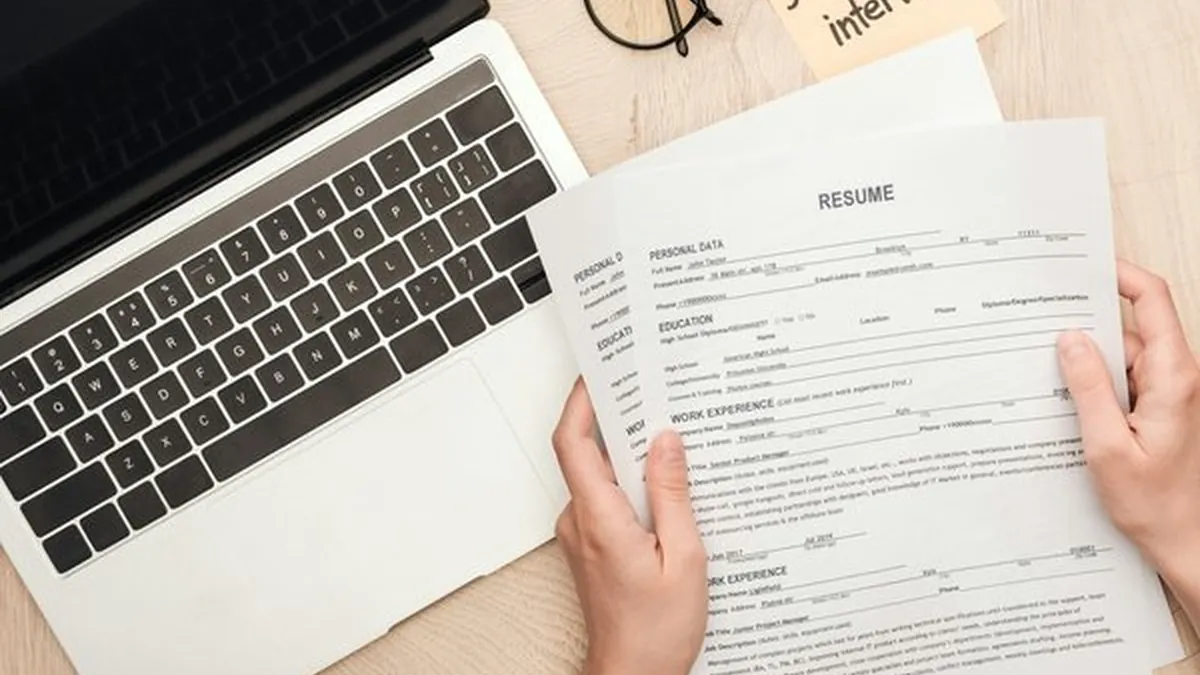
What AI is actually for on a resume
Using an AI resume writer well means understanding what it is for: drafting speed and language polish, not truth. AI can turn your scattered career notes into a clean one-page draft in minutes, and it can tighten flabby bullet points faster than any human editor. What it cannot do is know what you actually did. Every date, every job title, every claimed skill must come from you — because when AI fills gaps in your history, it fills them with plausible fiction, and fiction on a resume is a career-ending problem.
The fastest way to see the difference is to look at what a lazy AI resume sounds like. “Results-driven professional with a proven track record of leveraging synergies to drive impactful outcomes.” Every hiring manager has read that sentence four hundred times, and it says nothing. It is the sound of a model with no facts to work with, padding the emptiness with corporate filler. If your resume reads like that, the AI did not fail — you gave it nothing real to say.
The fix starts before you open the chat tool. Write down your raw material first: every role with start and end dates, three to five concrete things you did in each, and any numbers you remember — team size, budget, percentage improvements, users served. Rough notes are fine. This raw material is the one thing the AI cannot generate for you, and it is also the one thing that makes the final resume worth reading. Ten minutes of honest notes beats an hour of prompt engineering.
Start with raw material, not prompts
Now give the model a job with boundaries. A prompt that works: “Turn these notes into resume bullet points for a [job title] role. One line each, start each with a strong verb, include the numbers where I provided them, and do not invent any facts — if a detail is missing, leave it out or mark it [ADD].” That last instruction matters enormously. Without it, the model will smooth over your gaps with invented specifics, and you may not catch them all in review.
Mistake 1: letting AI invent your history
Mistake number one is letting AI invent your history. This is the big one, so be blunt about it: models will happily extend your employment dates, upgrade your title, add skills you never claimed, and describe projects you never touched — all in confident, professional language. Review every single line of the draft against your notes and your memory. If a bullet point describes something you cannot defend in an interview, delete it or fix it. Interviewers probe exactly the lines that sound impressive.
Mistake number two is the keyword stuffing the AI will do if you ask it to “optimize for ATS.” Applicant tracking systems do scan for keywords, but the winning move is honest alignment, not stuffing. Paste the job description into the chat and ask: “Which skills and terms from this job posting match my notes? List only the ones I genuinely have, and show me where each appears in my draft.” That keeps the ATS happy without turning your resume into a keyword salad that insults the human reader.
Mistake 3: accepting the default tone
Mistake number three is accepting the first draft's tone. AI defaults to a bland corporate register — “responsible for,” “assisted with,” “participated in” — the language of people describing work they watched from a distance. Go through and replace every weak verb with the strongest true one: built, led, cut, launched, fixed, grew. If you did not lead it, do not write “led.” Precision about your actual role is both more honest and more impressive than inflated verbs.
Mistake number four is the two-page sprawl. Unless you have a decade of relevant experience, your resume should be one page, and AI will not enforce that unless you tell it to. Give it the constraint up front — “this must fit on one page” — and then check the result yourself. Paste the final text into FreeToolsBox's Word Counter: a one-page resume typically runs 400 to 600 words depending on formatting (and how many pages 1,000 words fills explains why the answer varies). If you are at 900 words, you do not have a resume, you have a memoir — cut the oldest roles to one line each.
Mistake 5: the generic summary
Mistake number five is the generic summary at the top. “Motivated professional seeking opportunities” tells the reader nothing and wastes the most-read real estate on the page. Either write a two-line summary with your actual years of experience, your field, and one concrete strength — written by you, in your voice — or delete the summary entirely and let the experience section speak. AI-written summaries are the most robotic-sounding part of any AI resume; this is the paragraph most worth writing yourself.
A before-and-after shows how the edit pass works. Before (raw AI output): “Responsible for managing social media accounts and helping increase engagement through various content strategies.” After (human-edited): “Ran the company's Instagram and LinkedIn; grew followers from 2k to 11k in eight months with a weekly video series.” Same job, but the second version has a verb with a pulse, real numbers, and a specific method. That transformation — generic to specific — is the entire job of your edit pass.
Formatting is a place where AI advice is genuinely useful, within limits. Ask for a clean structure — reverse chronological, consistent date formats, clear section headers — and most models will produce something sensible. But keep the formatting simple: single column, standard fonts, no graphics, no tables, no text boxes. Fancy layouts break in applicant tracking systems, and a resume the ATS cannot parse is a resume nobody reads — a point Google's resume tips for job seekers make as well. Boring formatting is a feature.
Tailor per application from one master resume
Tailoring per application is where AI earns its keep. Keep one master resume with everything, then for each job ask the model to produce a tailored one-page version emphasizing the relevant experience — from your master, adding nothing new. This used to be an hour of careful rewriting per application; now it is ten minutes plus your review. The rule never changes: the model selects and reorders your real facts, it never creates new ones.
Cover letters deserve a mention because the same principles apply with one addition: voice. A cover letter in pure AI-ese — “I am thrilled to apply,” “my passion for excellence” — reads as automated because it is. Draft with AI for structure, then rewrite it in how you actually talk. Three short paragraphs: why this role, what you have done that maps to it, and a plain closing. Hiring managers skim cover letters in seconds; sounding like a real person is the whole game — Harvard's resume and cover letter guide is a solid free reference for the format.
Your LinkedIn profile needs the same treatment, because recruiters will cross-check it against your resume within seconds. Dates, titles, and company names must match exactly — discrepancies read as dishonesty even when they are just sloppiness. AI can help rewrite your About section from the same verified notes, but the no-invention rule applies double here: LinkedIn is public, former colleagues can see it, and an inflated title will be noticed by exactly the wrong people.
Delete the “References available upon request” line. It is dead space — every hiring manager assumes references exist, and the line signals a resume padded to fill the page. Keep a separate references document with names, titles, and contact details, and send it only when asked. The space you save is better spent on one more concrete bullet point about work you actually did.
Finally, keep the master resume alive. Update it the week you finish a project, while the numbers and details are fresh — not six months later when you are job hunting and reconstructing from memory. A living master document means every future tailored version starts from accurate material, and the AI has real facts to work with instead of gaps to fill. The best time to update your resume is when you do not need it.
Keep your LinkedIn consistent
There is an honest question underneath all of this: will recruiters know you used AI? Probably, if you skip the edit pass — the filler phrases are recognizable. But nobody objects to AI assistance; they object to resumes that sound like everyone else's and contain claims the candidate cannot defend. A heavily edited AI draft that is accurate and specific is simply a well-written resume. The tool is not the problem. The unreviewed output is.
Privacy matters here more than in most AI workflows. Your resume contains your full name, contact details, employment history, and sometimes your address — a complete identity kit. Do not paste it into a tool you do not trust, and check the provider's data policy before uploading — how to choose safe online tools covers what to look for. If you are currently employed and job hunting quietly, remember that anything you upload could theoretically surface in training data on free tiers. Paid tiers with no-training policies are the safer choice for personal documents.
The workflow that works, end to end
One more honest limit: AI cannot tell you what to leave out, because it does not know your strategy. It does not know you are pivoting careers and want the old field minimized, or that a six-month gap needs a one-line explanation rather than anxious padding. Those are judgment calls, and they are yours. Use the model for language and structure; keep the strategy — what to emphasize, what to cut, what story the page tells — firmly in human hands.
The workflow that works, end to end: write your raw notes with real dates and numbers, prompt the model with strict no-invention boundaries, tailor from your master resume per application, replace every weak verb by hand, check the length with a word counter, simplify the formatting for ATS, write the summary in your own voice, and read the final page aloud to catch anything that does not sound like you. Eight steps, and the AI does maybe three of them.
Read it aloud — that last step deserves emphasis. Robotic phrasing hides in silent reading; your ear catches it instantly. Any sentence you would never say out loud to a hiring manager needs rewriting. Your resume should sound like the most articulate version of you, not like a press release from a company you have never heard of.
The goal was never to avoid AI; it is to use it without surrendering authorship. Let it draft fast, tighten language, reformat, and tailor — then bring the judgment only you have: what is true, what matters, what to cut, and how you sound. A resume built that way gets past the software and survives the human. That is the only test that counts. Before you send it, run the final draft through FreeToolsBox’s Word Counter one more time — then read it aloud once, because the ear catches the robotic phrasing the eyes skip.