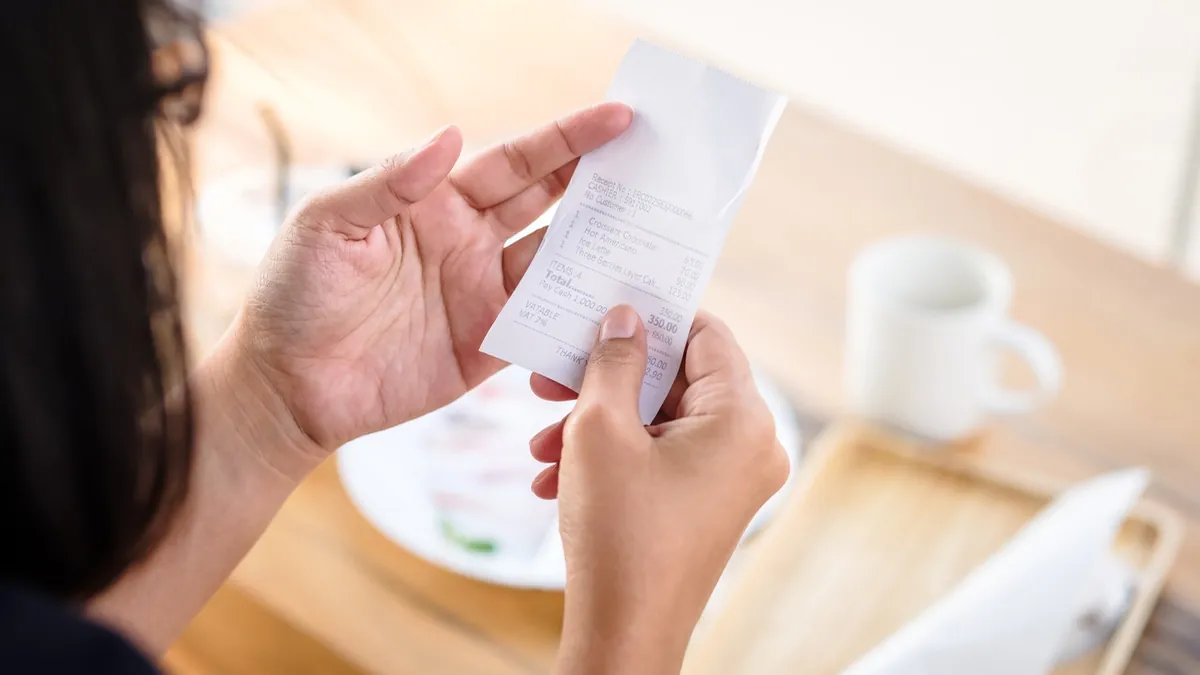
The one trick everything rests on
Learning how to calculate a tip in your head takes about two minutes and ends the awkward phone-under-the-table moment forever. The entire skill rests on one trick: finding 10 percent of any bill is trivial, and every other common tip is just 10 percent plus a small adjustment. Once that clicks, 15 and 20 percent follow in seconds.
The 10 percent trick is the foundation. Move the decimal point one place left. A ₹850 bill becomes ₹85. A $46.50 bill becomes $4.65. A €120 bill becomes €12. That is it — no division, no multiplication, just a decimal shift your brain can do while still holding a conversation. Every tip calculation in this post starts here.
Fifteen and twenty percent in seconds
Twenty percent is double the 10 percent. Bill of ₹850: 10 percent is ₹85, double it to ₹170. Bill of $46.50: 10 percent is $4.65, double to $9.30. You found a 20 percent tip with one decimal shift and one doubling — two operations, no calculator, no app. In the US, where 18 to 20 percent is the standard restaurant tip, this single move covers the most common real-world case.
Fifteen percent is 10 percent plus half of 10 percent. Take the ₹850 bill: 10 percent is ₹85, half of that is ₹42.50, add them for ₹127.50. For $46.50: $4.65 plus $2.33 (rounding the half) gives about $6.98 — call it $7. Slightly more work than 20 percent, but still three easy steps. Fifteen percent is a common baseline in many places and a reasonable default when service was fine but unremarkable.
Rounding is not cheating; it is the point. Nobody tips $6.98 — you tip $7. Round the bill first if that helps: on a ₹863 bill, call it ₹860 or even ₹900 in your head, find 10 percent, and adjust. The difference between a tip on ₹863 and a tip on ₹860 is pennies. Mental math is about speed and confidence, not accounting precision.
Splitting the bill without the awkwardness
Tax complicates things in some countries, so here is the rule: tip on the pre-tax subtotal, not the total with tax. In the US, the bill shows subtotal, then tax, then total — base your tip on the subtotal line. The difference is small on one meal, but it is the correct convention and it keeps you from over-tipping by habit. In India, where service charge (if any) is a separate line item, note that a service charge is not a tip — it goes to the establishment, and you decide the tip independently.
Splitting the bill is where mental math earns its keep. The fair method: divide the bill first, then tip on your share. Four friends, ₹2,400 bill: ₹600 each, and a 10 percent tip on your share is ₹60. Do not compute the tip on the whole bill and then divide — it gives the same number, but dividing first keeps everyone's share clean when people ordered differently. When shares are uneven, each person tips on their own portion. For the trickier social side — who owes what when orders differ wildly — see our guide to splitting bills fairly.
The common splitting mistake is forgetting tax and tip in the per-person math. If four people split a $120 subtotal evenly, each owes $30 plus their share of tax plus tip — not just $30. Agree the method before the bill arrives: even split, pay-for-what-you-ordered, or one person covers it and gets paid back. The math is easy; the social part is what needs the advance agreement.
When mental math meets its match
FreeToolsBox's Tip Calculator is the backup for the cases mental math handles badly: odd splits among six people, bills in unfamiliar currencies, or when you want the exact per-person total including tax. Use your head for the standard cases and the calculator for the messy ones — that division of labor is the whole point of having both skills.
Country norms vary enough to be worth a quick tour. In the US, 18 to 20 percent at sit-down restaurants is expected, and tips are a genuine part of wages — the IRS has dedicated rules for reporting them. In most of Europe, service is often included or rounding up the bill is enough — 5 to 10 percent for good service is generous. In India, 10 percent is a common restaurant tip where no service charge applies, and tipping is appreciated but not obligatory in most settings. In Japan, tipping can actually cause confusion or offense — good service is considered standard. When traveling, a thirty-second check of local norms beats any calculation.
Country norms in sixty seconds
Delivery and takeaway have their own conventions. For food delivery, 10 to 15 percent (or a flat amount that respects the driver's trip) is typical in the US; in India, a small amount via the app or in cash is customary. For takeaway you pick up yourself, tipping is optional — a little something for careful packing is nice but nobody expects a full percentage. Coffee shops with tip screens: a dollar or rounding up is fine; you are not obliged to pick 20 percent for a drip coffee.
Percentages beyond tipping use the same machinery, which is why the skill transfers. A 25 percent discount? Find 10 percent, double it for 20, add half of 10 percent for the extra 5. A 7 percent sales tax? 10 percent minus a bit under a third of it. Once your brain does decimal-shift math fluently, every percentage in daily life gets easier — discounts, interest, price comparisons.
FreeToolsBox's Percentage Calculator covers those wider cases: discount math, percentage change, what-is-X-percent-of-Y. The tip trick teaches you the mental model; the calculator handles the numbers when precision matters more than speed, like comparing two discount offers at the store.
The skill transfers beyond tipping
Practice cements it, and restaurant bills are free practice. Next time you eat out, compute the tip in your head before anyone reaches for a phone: shift the decimal, double or add-half, round. After three or four bills it becomes automatic — most people report it sticking within a week of casual use. That is the real payoff: a small, permanent upgrade to everyday confidence with numbers.
One last piece of etiquette worth knowing: if service was genuinely bad, reducing the tip and calmly telling the manager what went wrong helps more than leaving nothing silently. And if service was exceptional, tipping above the standard is noticed and remembered — regulars who tip well get treated like regulars who tip well. The math gets you the number; the judgment is yours.
So the whole method in one paragraph: shift the decimal for 10 percent, double it for 20, add half for 15, round freely, tip on the pre-tax amount, divide the bill before tipping when splitting, and check local norms when traveling. Two minutes to learn, useful for life.
Auto-gratuity, bars, hotels, and tip screens
Large parties often come with automatic gratuity — typically 18 percent for groups of six or eight, printed right on the bill. Check before adding your own tip on top; double-tipping on auto-gratuity is one of the most common restaurant overpayments. If the service was exceptional you can still add more, but make it a conscious choice rather than an accident.
Bars have their own rhythm. A dollar or two per drink is the standard US convention — on expensive cocktails the percentage method catches up on its own. The approach regulars use: tip a little generously on the first round and the bartender remembers you. Running a tab versus paying per drink does not change the total much, so pick whichever keeps your mental math simple.
Hotels involve several small tips rather than one big one: bell staff who carry your bags, housekeeping each day (left daily rather than at checkout, since staff rotate), valet parking. A few dollars or the local equivalent per service is the norm in the US; in India, small cash tips for room service delivery and housekeeping are customary but modest. None of these need percentage math — they are flat courtesies.
Digital tip screens have changed the psychology. When a tablet suggests 20, 25, or 30 percent for a counter-service coffee, remember the suggestion is set by the business, not by custom. Tipping a modest fixed amount — or nothing for pure counter pickup — is completely reasonable. The screen is allowed to ask; you are allowed to tap the custom amount button.
In India specifically, the picture is simpler than the American one. Most mid-range restaurants add no service charge, and a 10 percent tip for good service is generous and genuinely appreciated. Delivery apps let you tip in-app — a small amount during bad weather or late at night really matters to the rider. At street food stalls and casual eateries, rounding up the bill is the everyday version of tipping, and vendors notice and remember it.
The fastest way to lock in the skill is to narrate it once, out loud, on your next bill. Say the steps as you do them — shift the decimal, double it, round it — and the sequence moves from something you read into something your hands know. After that, every bill is a two-second calculation instead of a small moment of dread, and you will wonder why it ever felt like math at all.