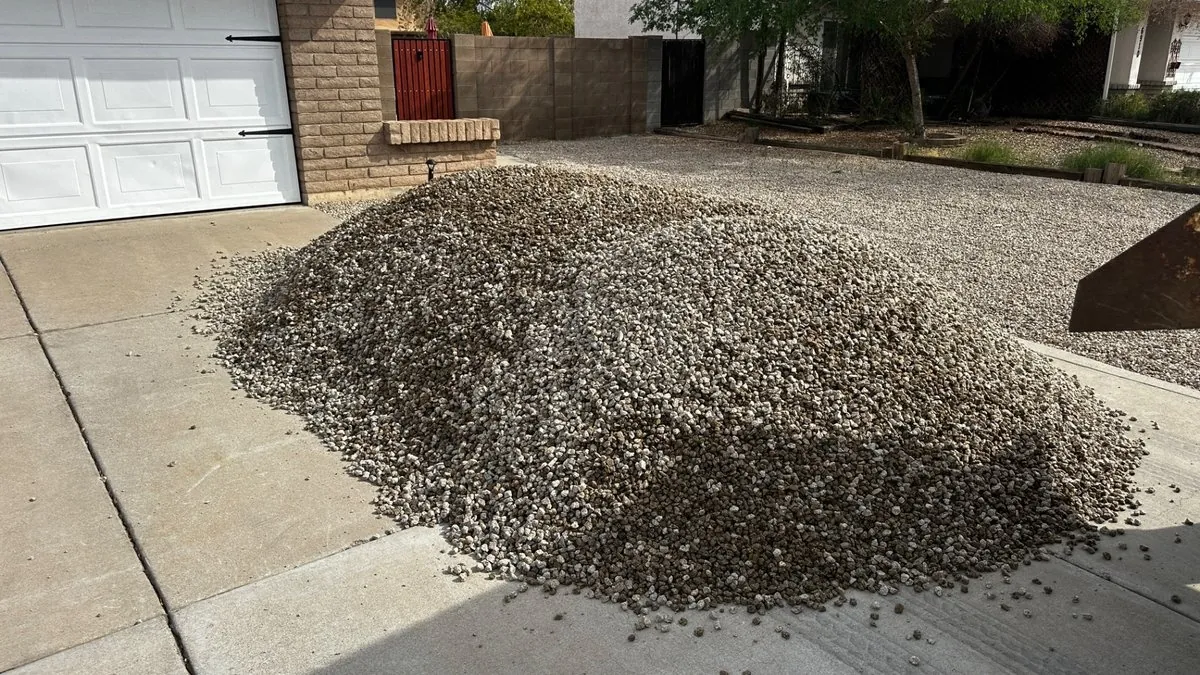
The amount of gravel you need is just a volume: measure the area's length and width in feet, multiply by the depth in feet, and you have cubic feet. Divide by 27 to get cubic yards, then multiply by about 1.4 to get tons, which is how most yards sell it. A typical 10 × 20 ft garden bed at 3 inches deep works out to 50 cubic feet, 1.85 cubic yards, or roughly 2.6 tons. Depth is the number people get wrong most often, so this guide starts there, then walks through worked examples for beds, driveways and round areas, and finishes with ordering and delivery tips.
The method never changes, whatever the project. Step 1: measure length and width in feet (convert inches by dividing by 12). Step 2: choose a depth and convert it to feet — 3 inches is 0.25 ft, 4 inches is 0.33 ft, 6 inches is 0.5 ft. Step 3: multiply length × width × depth to get cubic feet. Step 4: divide by 27 for cubic yards, and multiply the yards by the density, about 1.4 tons per cubic yard for typical gravel, to get tons. If you would rather skip the arithmetic, the gravel calculator runs exactly these steps with the depth and density built in.
How deep should the gravel be?
Depth depends on the job, and ordering a driveway's worth for a path wastes money while a path's depth on a driveway fails within a season. As working guidance: garden paths and walkways do well at 2-3 inches of gravel over landscape fabric; decorative beds and borders need 2-3 inches to suppress weeds and cover soil; a driveway surface course is usually 4-6 inches of gravel in total, built up in layers over a compacted base rather than dumped in one lift; French drains need enough stone to fill the trench around and above the pipe, often 12 inches or more of total trench depth filled with washed stone; parking pads and shed bases typically want 4-6 inches over a geotextile. When in doubt, build depth in compacted layers rather than one deep loose pour.
Choosing gravel: size and stone type
Stone choice changes the math slightly and the result a lot. Crushed stone with fines (often sold as crusher run or road base) compacts hard and is the right pick under driveways and pads. Washed angular stone around 3/4 inch (#57 in the trade) drains freely and suits French drains and driveway surface layers. Pea gravel is rounded and shifts underfoot — pleasant on paths and in dog runs, hopeless on a driven surface. River rock is decorative, sized larger, and mostly for beds and borders. Density hovers near 1.4 tons per cubic yard for all of them, but rounded stone settles less and angular stone locks together, which is why the angular types compact noticeably while pea gravel barely does.
Worked example: a 10 × 20 ft garden bed
Worked example one: a 10 × 20 ft garden bed at 3 inches deep. Convert the depth: 3 ÷ 12 = 0.25 ft. Volume = 10 × 20 × 0.25 = 50 cubic feet. Convert to yards: 50 ÷ 27 = 1.85 cubic yards. Convert to tons: 1.85 × 1.4 = 2.59, so about 2.6 tons. In practice you would order 3 tons or 2 cubic yards, because loads are rounded and a small surplus is far cheaper than a second delivery. Notice how the depth drove everything: the same bed at 2 inches needs only about 1.7 tons, and at 4 inches about 3.5 tons.
Worked example: a 12 × 50 ft driveway
Worked example two: a 12 × 50 ft driveway resurfaced at 4 inches. Depth in feet: 4 ÷ 12 = 0.33 ft. Volume = 12 × 50 × 0.33 = 200 cubic feet. Yards: 200 ÷ 27 = 7.41 cubic yards. Tons: 7.41 × 1.4 = 10.4 tons. A full driveway build is different from a resurface: most guides call for a base layer of larger crushed stone, compacted, with a finer surface layer on top, so price the layers separately. For a driveway-only estimate with layers and edging accounted for, the gravel driveway calculator is built for that case, while the general method here covers the resurface and top-up jobs most homeowners actually order.
Circles and irregular areas
Round and irregular areas use the same volume idea with a different area step. For a circle, area = π × radius²: a circular bed with a 5 ft radius has an area of 3.1416 × 25 = 78.5 sq ft, and at 3 inches deep the volume is 78.5 × 0.25 = 19.6 cubic feet, which is 0.73 cubic yards or about 1 ton. For an L-shaped or curved bed, split it into rough rectangles, work out each one, and add them; landscaping estimates tolerate a few percent of measuring slop because your depth will vary by at least that much anyway. Measure the radius to the middle of any edging, not the outside, to avoid quietly inflating the order.
Sloped ground steals depth quietly. On a site that drops a foot across its length, the downhill edge needs more stone to reach level, and a single average depth understates the order. Measure the depth at several points — corners and middle — and average them before calculating, or calculate the high and low halves separately as two rectangles. For a driveway that will be regraded, order for the finished grade, not today's ruts: filling a pair of 2-inch-deep wheel tracks along a 50 ft drive quietly adds the better part of a ton. If the base is soft clay, budget the first layer as sacrificial — some stone will punch into the soil no matter what the fabric promises.
Cubic yards versus tons: how gravel is sold
Suppliers sell gravel by the ton or by the cubic yard depending on region and stone type, so you need to move between the two. The bridge is density: a cubic yard of typical gravel weighs roughly 1.4 tons, with a real range of about 1.3 to 1.5 tons depending on the rock type and how wet it is — wetter stone and denser rock sit at the heavy end. That range is why the cubic yard calculator and the full method in how to calculate cubic yards matter when comparing quotes: a cheap per-ton price on heavy stone can cost more per yard of coverage than a higher price on lighter stone. Always compare quotes in the same unit before deciding.
Compaction and settling: why to order extra
Loose gravel does not stay the depth you spread it. Traffic and rain compact a surface layer by roughly 10-20 percent over the first season, edges slump into soft soil, and some stone migrates into the ground below if there is no fabric or base. The practical fix is to order about 5-10 percent more than the bare calculation for paths and beds, and toward the top of that range for driveways and soft ground. That extra is not waste: it becomes your top-up pile for the thin spots that appear after the first few storms. Ordering exactly the calculated amount almost guarantees a visible shortfall somewhere, followed by a minimum-delivery fee for a tiny second load.
Bulk delivery versus bags
For anything over about a ton, bulk delivery beats bags by a wide margin. A standard pickup bed carries roughly 1 to 1.5 tons safely, and delivery trucks commonly haul 5 to 15 tons per load depending on size, so a 10-ton driveway order is usually a single trip. Bagged gravel from a home center typically comes in 0.5 cubic foot bags: one cubic yard is 54 bags, which makes bagging a 7-yard driveway a 378-bag exercise in false economy — bags make sense for a 1-ton circle bed or for topping up, not for driveways. Ask the yard to dump on a tarp or hard surface rather than bare soil, and confirm the truck can reach the spot before it arrives loaded.
Plan the dump before the truck leaves the yard. Gravel should land as close to the work area as the truck can safely reach, on a hard surface or a heavy tarp — stone dumped on lawn or bare soil picks up dirt, kills grass in a neat pile shape, and loses its bottom layer to the ground. Check overhead wires and soft shoulders on the access route, and tell the yard about septic fields or buried lines the truck must not cross. Spreading goes fastest in wheelbarrow loads worked outward from the pile, raking to depth against a string line or a marked stake, then compacting paths and driveways in passes. Work in dry weather if you can: wet stone is heavier per load and mud underneath swallows depth.
Gravel mistakes that cost money
The mistakes that cost money are consistent. Using depth in inches inside a feet-based formula inflates the order twelvefold — always convert depth first. Forgetting that a driveway needs a base layer, then watching the surface stone vanish into mud within a year. Comparing a per-ton quote against a per-yard quote without the density conversion. Ordering the exact calculated figure with no allowance for compaction or spillage. And measuring only the tidy rectangle of a bed that actually flares at one end; measure the widest length and longest width and accept a small surplus. Each of these is cheap to avoid at the measuring stage and expensive to fix after the truck has left.
Before you order, run this checklist: measure twice in feet; pick the depth for the job, not a guess; convert depth to feet; compute cubic feet, yards and tons; add 5-10 percent for compaction; decide bulk versus bags; and confirm delivery access and a dump spot. If any step feels shaky, plug the same numbers into the gravel calculator and compare — the two methods agreeing is the best sign your order is right. Gravel is one of the few materials where a modest surplus stays useful for years, so when the math lands between two load sizes, take the larger one and keep the leftover pile for patching.