A board foot is a unit of lumber volume equal to a board 1 inch thick, 12 inches wide and 1 foot long — 144 cubic inches of wood. To calculate board feet, multiply thickness in inches by width in inches by length in feet, then divide by 12. A 2 × 6 board 10 feet long is (2 × 6 × 10) ÷ 12 = 10 board feet, and at $4.50 per board foot it costs $45. Hardwood dealers price lumber by the board foot because boards come in random widths and lengths, so volume — not the piece — is the fair basis for charging.
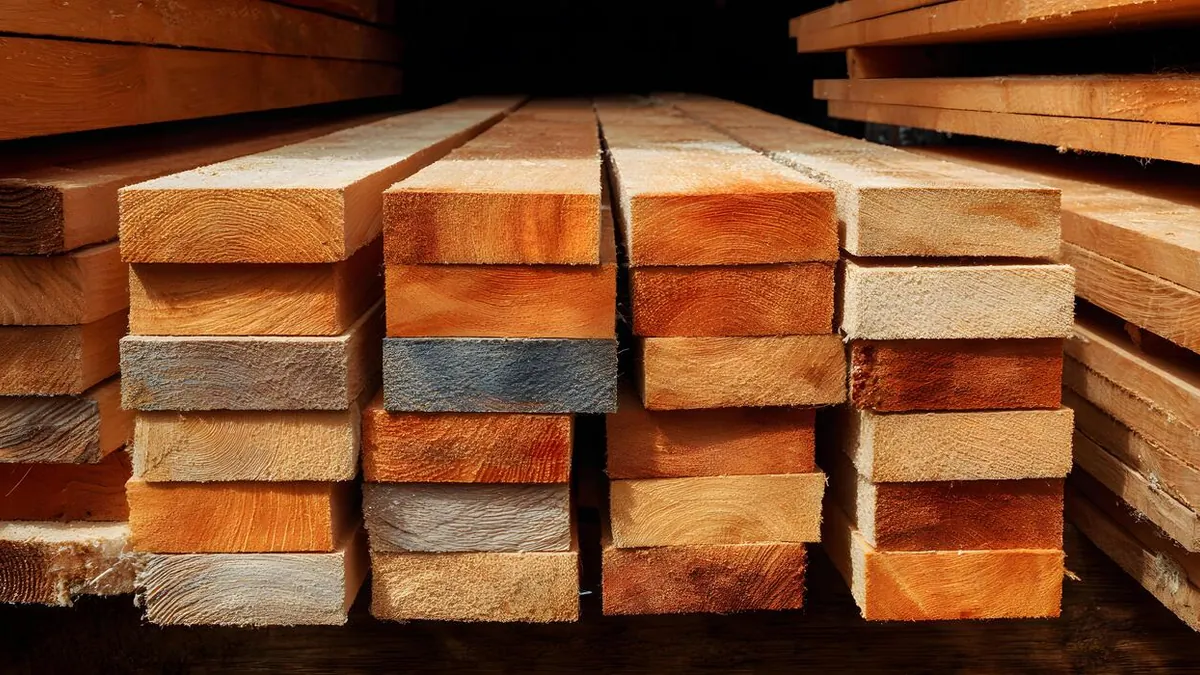
The reason board feet exist at all is that a hardwood yard is not like a home center. Instead of neat stacks of identical 2 × 4s, you get boards of whatever width the log produced — 5 inches here, 9 inches there — in lengths from 6 to 12 feet, stacked by species and thickness. Pricing by the piece would be absurd, and pricing by the pound unpredictable, so the trade settled on volume. Quarters describe thickness: 4/4 (four-quarter) is rough-sawn 1 inch, 5/4 is about 1.25 inches, 8/4 is 2 inches. If you want to skip the mental arithmetic at the yard, the board foot calculator totals a whole cut list, waste included, from the dimensions you type in.
Hardwood grades, briefly
Grades decide how much of a board you can actually use, and they are worth one paragraph before the math. Hardwood grading in the US is overseen by the National Hardwood Lumber Association and sorts boards by the proportion of clear, defect-free cuttings they yield: Firsts and Seconds (FAS) at the top, then Selects, then the Common grades — No. 1 Common, No. 2 Common — that trade more defects for a much lower price per board foot. A cheaper grade is not automatically a bargain: if your parts are long and wide, you may cut away the savings. But for small parts, Common grades with defects cut around them are how experienced woodworkers stretch a budget. The grade is stamped or chalked at the yard; ask what you are looking at before you compare prices.
Nominal versus actual sizes: the board foot trap
Now the trap that catches almost everyone once: the sizes on the label are nominal, not actual. A softwood 2 × 4 is actually 1.5 × 3.5 inches; a 1 × 4 is actually 0.75 × 3.5 inches; a 2 × 6 is 1.5 × 5.5 inches; a 4 × 4 is 3.5 × 3.5 inches. The names preserve the rough-sawn dimensions from before the board was dried and surfaced smooth. Here is the honest complication: hardwood board feet are traditionally tallied from the board's nominal (rough) dimensions — the thickness and width before final surfacing — because that is the volume of wood the mill produced and sold. So a surfaced 4/4 board that measures 13/16 in thick on your calipers still bills as 1 inch in the board-foot math, and your invoice is not an error.
Softwood plays by visibly different rules, and confusing the two systems causes most board-foot arguments. Dimension lumber for framing — 2 × 4s, 2 × 6s, studs — is sold by the piece at a posted price per board, full stop; nobody at a home center will quote you board feet for studs, even though a stud technically contains about 5.5 board feet by nominal measure. Hardwood, exotics and thick stock sell by the board foot at specialty yards. Cedar and treated deck boards sit in between: priced by the piece or by the linear foot, and for an actual deck build the deck board calculator counts those pieces for you. Knowing which system a yard is using — and asking, before the boards are cut, whether the tally is nominal or actual — prevents nearly every surprise at the register.
Worked example: eight 2 × 6 boards
Worked example: eight 2 × 6 boards, each 10 feet long, for a raised garden bed. Per board: (2 × 6 × 10) ÷ 12 = 120 ÷ 12 = 10 board feet. Eight boards: 8 × 10 = 80 board feet. If this were hardwood at $4.50 per board foot, the bill is 80 × $4.50 = $360 before tax. In a home center the same eight softwood boards would simply ring up at the per-piece price, but the board-foot figure still earns its keep: it lets you compare two yards' per-piece prices on equal terms, convert a cut list into an order of random-width stock, and sanity-check a hardwood invoice in seconds.
Project example: a tabletop in 1 × 8 boards
A project example: a tabletop glued up from 1 × 8 boards, 6 feet long. Each board is (1 × 8 × 6) ÷ 12 = 48 ÷ 12 = 4 board feet. Five boards side by side make a top about 36 inches wide (remember each is actually 7.25 in wide, an important actual-size detail for the finished width), and the glue-up total is 5 × 4 = 20 board feet. Now the step beginners skip: waste. Between ripping edges straight, cutting out a knot or a split end, and squaring the finished top, plan on 10-15 percent more wood than the project math says — so buy about 23 board feet for this top, and pick boards a few inches over length so defects at the ends can be trimmed away.
Thickness quarters: 4/4, 5/4 and 8/4
Thickness quarters deserve a fuller explanation, because they are the unit the yard actually speaks. Rough hardwood is sold as 4/4 (about 1 in), 5/4 (about 1.25 in), 6/4 (about 1.5 in), 8/4 (about 2 in) and occasionally 12/4 (about 3 in) for legs and turning blanks. After drying and surfacing two sides, expect to lose roughly 1/8 to 3/16 in, so finished 4/4 stock is usually 13/16 in thick. If a design needs a true finished 1 inch — a shelf that must match an existing one — buy 5/4 and plane down, because no amount of surfacing 4/4 stock can finish at a full inch. The board foot formula uses the nominal quarter thickness, which is one more reason your tally and the yard's agree only when both use nominal figures.
Waste, grade and surfacing losses
Waste is not carelessness; it is the physics of turning trees into furniture. Boards contain knots, checks, waney edges and grain that runs the wrong way for your part, and a cut list drawn at exactly the project's volume assumes every inch of every board is usable, which is never true. Common buying guidance is 10 percent extra for straight, clear softwood parts, 10-15 percent for typical furniture hardwood work, and up to 20 percent if the design demands long clear spans or matched grain, where you reject more of each board. Surfacing matters too: wood surfaced on two sides (S2S) or four sides (S4S) has already lost its planer allowance, and rough stock you mill yourself loses more — which is exactly the wood the nominal tally charges you for.
Board feet versus linear feet versus cubic feet
Three units circulate in a lumber yard and they are not interchangeable. A board foot is volume: 144 cubic inches, the hardwood standard. A linear foot is just length, ignoring width and thickness: decking, trim and molding price this way, and one linear foot of 1 × 8 contains two-thirds of a board foot while a linear foot of 2 × 12 contains two. A cubic foot is raw volume without the board trade's conventions — 12 board feet equal 1 cubic foot — and appears mainly in log scaling and shipping. When a price seems too good, check the unit first: $3 per linear foot for a wide thick board can be dearer than $6 per board foot, and the conversion takes ten seconds.
Decking is the friendliest place to practice, because a deck forces volume, piece count and coverage into one decision. Deck boards themselves are sold by the piece or linear foot, so the tool for that job counts boards across the deck, joists and screws rather than board feet; the deck board calculator does that count directly. But the framing under a deck — beams and joists quoted by a real lumber yard — often is tallied in board feet, and the under-structure of a mid-size deck can run to several hundred board feet. Running both numbers before you shop keeps the yard's invoice from being the first time you see either figure.
Shopping strategy at a hardwood yard is mostly defect management. Bring the cut list with the longest and widest parts marked, and select boards whose clear sections can yield them — a 10 ft board with a knot 4 ft from one end is really a 6 ft board plus a 4 ft board. Sight down each board for bow, crook and twist; slight bow can be ripped out, twist mostly cannot. Check the ends for splits and budget to trim an inch or two. Stack picks flat in the cart, sticker them flat again at home, and let them acclimate to the shop for several days before final milling on furniture-grade work — wood moves with humidity, and dimensions milled today settle by the weekend.
How the yard tallies your bill
How yards bill board feet explains the last few mysteries. The tally is usually rounded to whole board feet per board, fractions dropped or rounded by house rule, and a single board may be measured at the widest point or the average width depending on the yard and the grade — rough, random-width stock is not a laboratory measurement. Minimum charges for planing, ripping or cutting to length are common and legitimate. None of this is sinister, but it means your home calculation and the yard's tally can legitimately differ by a few percent. Recompute with the yard's stated method rather than your assumption, and a disputed invoice usually resolves itself.
Common board foot mistakes
The common mistakes, collected: computing board feet from actual dimensions and then accusing the yard of overcharging — remember the tally is nominal by tradition; treating a softwood per-piece price as if it were per board foot; forgetting that length enters the formula in feet, not inches, which understates the answer twelvefold; planning zero waste and running one board short on a Sunday; and ignoring the actual finished width when a glue-up must hit an exact size. Get the system right — nominal tally, correct units, waste included — and board feet become the simplest number in the woodshop. For the arithmetic itself, run your cut list through the board foot calculator before you leave for the yard.